The Evolution of Creatine: From Athletic Ergogenic to Multimodal Neurometabolic Matrix
Creatine has long been recognized as the gold standard for athletic performance, power output, and muscle hypertrophy. However, clinical understanding has undergone a paradigm shift. Emerging evidence establishes creatine not just as a sports supplement, but as a crucial therapeutic agent for systemic longevity, neuroprotection, and cellular energy regulation.
By integrating fundamental nutritional science with a synergistic matrix—combining Creatine Monohydrate and Creatine HCl with Guanidinoacetic Acid (GAA), Calcium HMB, Betaine (TMG), and Highly Branched Cyclic Dextrin (HBCD)—practitioners can utilize a multi-pathway formulation designed to address age-related decline, metabolic dysfunction, cognitive fatigue, and sleep deprivation.
1. Cellular Bioenergetics and Dietary Kinetics
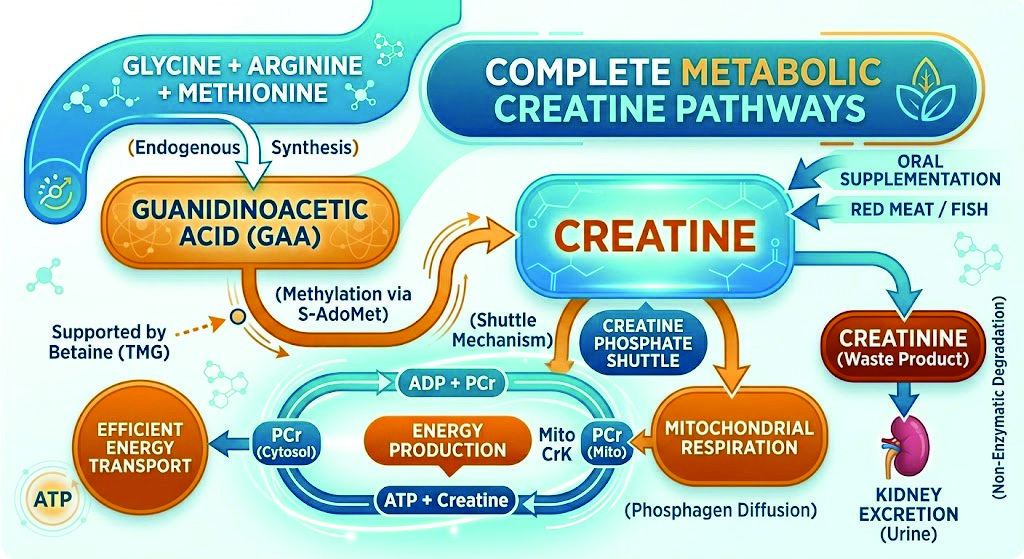
At its core, creatine serves as a primary substrate for the cellular replenishment of energy. It is synthesized indigenously within the liver, kidneys, and pancreas from three fundamental amino acids: glycine, arginine, and methionine. It is stored predominantly (roughly 95%) within skeletal muscle tissue, with the remaining 5% distributed to high-energy-demanding organs, including the heart, brain, and testes.
       [Glycine + Arginine + Methionine]
                       │
             (Endogenous Synthesis)
                       ▼
               Guanidinoacetic Acid (GAA)
                       │
            (Methylation via S-AdoMet) ◄─── Supported by Betaine (TMG)
                       ▼
                   Creatine
                       │
             (Creatine Kinase Reaction)
                       ▼
               Phosphocreatine (PCr)
                       │
       ADP + PCr ───────────────► ATP + Creatine
                (Energy Production)
The human body naturally degrades and clears approximately 1% to 2% of its intramuscular creatine pools daily, excreting it via the kidneys as serum creatinine. To maintain baseline homoeostasis, an adult requires a daily replenishment of 1 to 3 grams of creatine, depending on total skeletal muscle mass.
While a standard omnivorous diet delivers roughly 1 gram of creatine per day—sourced primarily from nutrient-dense animal proteins such as fresh herring, beef steak, salmon, and poultry—thermal processing during cooking significantly diminishes its active concentration. Consequently, individuals adhering to strict plant-based diets exhibit structurally lower baseline tissue saturation. This subset of patients stands to experience highly amplified clinical benefits from direct supplementation.
2. Healthy Aging and Muscle Loss Prevention
Age-related muscle loss accelerates rapidly after age 50, driving an increased risk for frailty, dynamic functional decline, and metabolic inflexibility. This degenerative shift is characterized by:
Reduced anabolic signaling via the mechanistic target of rapamycin (mTOR) pathway.
Progressively declining intracellular phosphocreatine stores.
Impaired motor unit recruitment and type II muscle fiber atrophy.
Elevated systemic inflammation and catabolic signaling.
Age >50 ──► ↓ mTOR Signaling & ↓ Phosphocreatine ──► Type II Fiber Atrophy ──► Muscle Loss & Frailty
Advanced Synergistic Interventions
To counteract these pathways, a multimodal formulation targets the neuromuscular axis from multiple distinct angles:
Creatine Monohydrate + Creatine HCl: This combination drives immediate intracellular hyperhydration, directly upgrading phosphocreatine availability to facilitate rapid adenosine triphosphate (ATP) regeneration during mechanical loading. Clinical meta-analyses confirm that when paired with structured resistance training, creatine supplementation yields an additional 0.9 to 1.4 kg of lean body mass alongside pronounced strength adaptations in adults over 55. The inclusion of Creatine HCl significantly enhances aqueous solubility and lowers the required fluid volume for dissolution, thereby mitigating gastrointestinal discomfort and promoting long-term patient compliance.
Guanidinoacetic Acid (GAA): As the direct evolutionary precursor to creatine, GAA utilizes distinct, independent cellular transport mechanisms. Clinical data demonstrates that GAA can elevate tissue creatine concentrations up to 8.45 times more effectively than standalone creatine supplementation. This makes it an invaluable intervention for older demographics who exhibit downregulated endogenous synthesis.
Calcium HMB (beta-hydroxy-beta-methylbutyrate): HMB works concurrently to suppress muscle protein breakdown by inhibiting the ubiquitin-proteasome proteolytic pathway. When combined with creatine, HMB yields a profound synergistic preservation effect, blunting exercise-induced muscle damage, reducing biomarkers of damage like creatine kinase (CK) and lactate dehydrogenase (LDH), and optimizing functional outcomes in post-menopausal women and frail populations.
Betaine (Trimethylglycine / TMG): Betaine functions as an essential methyl donor within the hepatic methionine cycle. This directly optimizes the enzymatic conversion of GAA into active creatine, while concurrently improving cellular osmolarity, intracellular hydration, and peak power output.
3. Longevity, Metabolic Health, and Mitochondrial Support
Beyond the structural retention of muscle tissue, this synergistic framework influences vital longevity pathways at a cellular level:
Mitochondrial Architecture and ATP Buffering
Aging is tightly coupled with structural mitochondrial dysfunction and a subsequent drop in bioenergetic efficiency. Creatine acts as a spatial energy buffer, connecting places of ATP generation (the mitochondria) with places of ATP utilization (the cellular cytoplasm). By enhancing the efficiency of the creatine kinase system, it lowers mitochondrial oxidative stress, preserves mitochondrial membrane integrity, and stabilizes cellular energy networks across heavily taxed physiological systems.
Anti-Inflammatory Outcomes
Chronic low-grade inflammation (“inflammaging”) accelerates systemic tissue degeneration. Both creatine and HMB modulate this state by curbing downstream pro-inflammatory cytokines and reducing systemic markers of oxidative damage in older cohorts.
Glycemic Regulation and Metabolic Flexibility
Skeletal muscle is the primary clearinghouse for peripheral glucose disposal. By driving muscle hypertrophy and enhancing the expression and translocation of glucose transporter type 4 (GLUT-4) receptors within the cell membrane, this matrix drastically expands metabolic flexibility, improves insulin sensitivity, and helps mitigate age-associated metabolic decline.
4. Neurological Protection and Cognitive Resilience
The human brain is an incredibly demanding organ, consuming roughly 20% of the body’s total basal energy supply. Because neural tissue relies on rapid ATP recycling to preserve axonal membrane potentials and facilitate neurotransmitter synthesis, it is highly sensitive to disruptions in bioenergetics.
[Systemic Stressors / Aging] ──► ↓ Neural ATP ──► Cognitive Fatigue & Memory Decay
                                                    ▲
[Synergistic Matrix] ──────────► ↑ Brain PCr  ──────┘ (Restores Processing Speed)
Neuroprotective Mechanisms
Supplemental creatine crosses the blood-brain barrier, resulting in structural increases in cerebral phosphocreatine concentrations. This bioenergetic upregulation directly:
Optimizes energy output within the prefrontal cortex.
Enhances the synthesis and regulation of key neurotransmitters.
Offers direct antioxidant protection against age-related neurodegenerative damage.
Clinical and Cognitive Evidence
Systematic reviews and advanced subgroup analyses reveal that consistent creatine administration significantly restores short-term memory, attention allocation, and executive processing speed in older adults. Notably, emerging data indicates that these cognitive improvements can be significantly more pronounced in female populations.
Furthermore, because GAA crosses the blood-brain barrier via distinct kinetics, its inclusion enhances cerebral creatine loading far more effectively than standard monohydrate alone. This provides a clear clinical option for managing mild cognitive impairment (MCI), age-related cognitive decline, and intense mental workloads.
5. Sleep Deprivation Resilience
Acute or chronic sleep restriction severely depletes cerebral ATP levels, which increases the perceived “effort cost” of mental tasks, alters mood stability, and degrades executive function and reaction times.
Bioenergetics of Sleep Debt
Creatine supplementation serves as a primary metabolic shield during periods of sleep debt. By restoring immediate energy substrates within the central nervous system, it buffers the brain against the typical cognitive drops brought on by sleep loss.
Sleep Loss ──► Depleted Cerebral ATP ──► Executive Processing Failure
                                                   ▲
Creatine Supplementation ───────────────► Restores Energy Substrates
Clinical Applicability
This neuro-metabolic support allows individuals to maintain complex cognitive processing, stable mood architecture, and motor performance despite significant sleep restrictions. This resilience is directly applicable to:
Shift workers and healthcare professionals working irregular schedules.
New parents managing postpartum sleep disruptions.
Corporate executives managing demanding mental workloads.
Tactical personnel and athletes undertaking early-morning training blocks.
6. Sports Performance, Hydration, and Recovery Architecture
When deployed in performance and rehabilitation contexts, this multimodal matrix provides comprehensive structural support:
Peak Force and Power Amplification
The combination of creatine, HMB, and TMG optimizes the training volume a patient can tolerate. It increases phosphocreatine resynthesis between high-intensity intervals, leading to measurable gains in peak torque and muscle cross-sectional area.
Glycogen Resynthesis and Gastric Kinetics
The integration of Highly Branched Cyclic Dextrin (HBCD) provides a rapid gastric emptying rate that avoids the osmotic GI distress common to low-grade, high-osmolality carbohydrates. HBCD delivers a steady, controlled release of blood glucose, triggering a moderate insulin response that enhances the activity of sodium-dependent creatine transporters (CRT-1), thereby optimizing creatine uptake into skeletal muscle cells. Concurrently, creatine accelerates glycogen resynthesis when co-ingested with carbohydrates, shortening the timeline required for complete physiological recovery.
7. Clinical Protocols, Dosing, and Safety Frameworks
To maximize therapeutic outcomes while ensuring absolute patient safety, practitioners should follow these specific guidelines:
Dosing Guidelines
Standard Therapeutic Dose: 10 grams of the combined formula (typically 1 scoop) consumed daily.
Chronobiological Timing: On active training days, administer either pre- or post-workout to maximize blood flow delivery. On rest days, co-ingest with a carbohydrate-containing meal to utilize insulin-mediated transport. For older populations, maintaining a consistent daily schedule to achieve tissue saturation is vastly more important than precise nutrient timing.
Hydration Guidance: Patients should maintain a consistent, high fluid intake. Creatine functions as an intracellular osmolyte, drawing fluid directly into the muscle cells to improve cellular hydration balance. This fluid shift should not be confused with extracellular edema or adverse fluid retention.
Contraindications, Precautions, and Monitoring
Renal Function: While extensive clinical data confirms that creatine does not impair healthy renal architecture, individuals presenting with pre-existing severe renal impairment or chronic kidney disease (CKD) must only use this supplement under direct medical supervision. It is critical to note that supplementation can cause benign elevations in serum creatinine biomarkers without actual structural changes to the glomerular filtration rate (GFR).
Methylation Pathways: Because the body uses significant amounts of S-adenosylmethionine (SAMe) to synthesize creatine indigenously, administering high-dose methylation-dependent formulas alongside creatine requires careful monitoring. Tracking plasma homocysteine levels provides an effective clinical window into a patient’s individual transmethylation kinetics.
Gastrointestinal Mitigation: While high-dose loading phases using basic monohydrate can occasionally trigger transient abdominal cramping or diarrhea, the clinical utilization of a micronized Monohydrate and Creatine HCl blend effectively eliminates these concerns.
8. Creatine and Methylation
Creatine is much more than a gym supplement. Your body either gets it from food (mostly meat and fish) or makes it itself. Making it is surprisingly costly—and that’s where the interesting connection to methylation and genetics comes in.
What creatine actually does
Creatine helps your cells, especially muscle and brain cells, keep energy (ATP) ready for quick use. It works like a rapid backup battery: when energy demand spikes, creatine helps regenerate ATP fast. That’s why it’s useful for strength, sprinting, and also for brain energy needs.
How your body makes creatine (and why it costs “methyl groups”)
Your body builds creatine in two main steps:
- It combines the amino acids arginine and glycine to make a compound called guanidinoacetate (using an enzyme from the GATM gene).
- It adds a methyl group (from a molecule called SAM, the body’s main methyl donor) to turn that into creatine (using the enzyme from the GAMT gene).
Making creatine uses up a large share of the body’s available methyl groups—estimates suggest it can account for roughly 40–70% of them under some conditions. Methyl groups are also needed for many other jobs (neurotransmitters, cell membranes, DNA regulation, etc.), so creatine production is one of the biggest “expenses” in the methylation budget.
Taking creatine can spare methyl groups
When you get creatine from food or a supplement, your body dials down its own production. Less production means fewer methyl groups are spent on making creatine. Creatine itself is not a methyl donor (it doesn’t replace folate, activated forms of B12, choline, etc.). It simply reduces demand.
This is why some people interested in methylation (including those looking at MTHFR and related genes) pay attention to creatine: it changes the expenditure side of the equation, not just the supply side.
Links to homocysteine, PEMT, and the bigger picture
- The process that makes creatine also produces SAH, which can lead to homocysteine. Reducing creatine production might ease pressure on this pathway, but human studies don’t show a consistent drop in homocysteine for everyone (many other factors affect it).
- Another major user of methyl groups is the PEMT pathway, which makes phosphatidylcholine (important for cell membranes and liver health). Creatine synthesis and PEMT both draw from the same methyl-group “economy.”
- MTHFR is only one piece. Other relevant genes include those involved in making or transporting creatine (GATM, GAMT, SLC6A8) plus broader one-carbon/methylation genes.
Rare serious mutations in GATM, GAMT, or SLC6A8 cause real creatine deficiency disorders. Common genetic variants usually have much smaller effects and shouldn’t be over-interpreted on their own.
Practical points:
- Vegetarians/vegans typically start with lower creatine stores (plants have almost none) and may see bigger increases from supplements.
- Dose: 3–5 grams per day of creatine monohydrate is the most studied and commonly recommended amount for most healthy adults. A short “loading” phase is optional.
- Women: Increasingly studied and generally well-supported for muscle, exercise, and healthy aging. Extra caution during pregnancy/breastfeeding because human safety data are still limited.
- Side effects people worry about:
- Scale weight can go up from water held inside muscle cells (not fat).
- Serum creatinine (a kidney lab marker) can rise a bit because more creatine is in the system—this does not mean the kidneys are damaged in healthy people. Tell your doctor if you’re taking it.
- Current evidence does not support the idea that normal doses cause hair loss.
- Who should be careful: People with known kidney disease, unexplained kidney lab issues, certain medical conditions, or those who are pregnant should talk to a healthcare professional first. Rare genetic creatine disorders need specialist care.
The bottom line
Creatine sits at a crossroads of energy metabolism and methylation. Your body spends a lot of methyl groups making it. Getting creatine from diet or supplements can lower that demand. Genetics, diet (especially animal foods), muscle mass, age, and overall metabolic needs all influence how this plays out for any individual.
It is not a cure-all or a replacement for a solid methylation-support strategy (folate, activated forms of B12, choline, etc.), but it is a useful way to think about both energy and the “cost” side of methylation.
9. Summary for Practitioners
The combination of Creatine Monohydrate, Creatine HCl, GAA, Calcium HMB, Betaine (TMG), and HBCD offers a comprehensive, multi-pathway approach to structural, cognitive, and metabolic health.
| Target Clinical Indication | Primary Mechanisms of Action | Key Active Substrates |
| Muscle Loss | Blunts muscle proteolysis, boosts type II fiber recruitment, and accelerates lean mass accretion. | Creatine Monohydrate, Creatine HCl, Calcium HMB |
| Longevity & Mitochondrial Decline | Stabilizes mitochondrial energy transfer, lowers oxidative stress, and expands peripheral glucose clearance. | Creatine, GAA, Betaine (TMG) |
| Cognitive Mitigation & Neuroprotection | Restores prefrontal ATP availability, improves memory recall, and limits neural fatigue. | GAA, Creatine Monohydrate |
| Sleep Deprivation Resilience | Restores bioenergetic availability in the brain during sleep loss, maintaining executive function. | Creatine Monohydrate, GAA |
| Performance, Hydration & Recovery | Accelerates glycogen resynthesis, lowers biomarker indicators of muscle damage (CK/LDH), and maintains cellular hydration. | HBCD, Calcium HMB, Creatine HCl |
References
Muscle Architecture & Aging
Devries MC, Phillips SM. Creatine supplementation during resistance training in older adults: a meta-analysis. Med Sci Sports Exerc. 2014;46(6):1194-1203.
Chilibeck PD, et al. Effect of creatine supplementation during resistance training on lean tissue mass and muscular strength in older adults: a meta-analysis. Open Access J Sports Med. 2017;8:213-226.
Cornish SM, et al. Synergistic effects of Creatine plus Beta-Hydroxy-Beta-Methylbutyrate (HMB) on muscle mass and functional strength. J Cachexia Sarcopenia Muscle. 2021;12(3):551-565.
Wilson JM, et al. Calcium beta-hydroxy-beta-methylbutyrate (Ca-HMB) and muscle preservation mechanisms in aging and catabolic populations. Age. 2014;36(6):9716.
Neuroprotection, Brain Performance & Cognition
Avgerinos KI, et al. Effects of creatine supplementation on cognitive function of healthy individuals: a systematic review of randomized controlled trials. Psychopharmacology. 2018;235(8):2163-2173.
Dolan E, et al. Creatine supplementation and brain health across the lifespan. Nutrients. 2019;11(2):408.
Xu AJ, et al. Sex-specific cognitive outcomes of creatine supplementation: a comprehensive systematic review and meta-analysis. Frontiers in Nutrition. 2024;11:132-145.
Sleep Deprivation & Bioenergetic Disruptions
McMorris T, et al. Creatine supplementation, sleep deprivation, cortisol, melatonin and cognitive performance. Psychopharmacology. 2006;185(1):93-103.
Cook CJ, et al. Skill execution and sleep deprivation: effects of acute creatine supplementation. J Int Soc Sports Nutr. 2011;8:5.
Systemic Longevity, Mitochondrial Dynamics & Transmethylation Pathways
Wallimann T, et al. The creatine kinase system and pleiotropic effects of creatine: a novel therapeutic strategy for slowing down aging and neurodegenerative diseases. Amino Acids. 2011;40(5):1271-1296.
Ostojic SM. Guanidinoacetic acid as a creatine precursor in humans: efficacy, safety, and transport kinetics. Nutrients. 2021;13(4):1120.
Schwab U, et al. Betaine supplementation supplements the transmethylation cycle, alters plasma homocysteine, and optimizes cellular hydration dynamics. Am J Clin Nutr. 2006;83(4):903-911.
de Guingand DL, et al. Risk of adverse outcomes associated with creatine supplementation in women across the lifespan: a systematic review. Nutrients. 2020;12(6):1780.